
The French duo Daft Punk was, without a doubt, one of the most influential musical acts in modern pop, dance, and electronic music. The two guys behind the masks were Guy-Manuel de Homem-Christo and Thomas Bangalter, who built their sound around disco, electronic music, and classic rock.
From the late 1990s until their breakup in 2021, Daft Punk set out to make dance music that felt both innovative and accessible. Their blend of electronic music, rock, and pop remains a major influence on today’s pop and rock scenes.
What Are Daft Punk’s Influences?
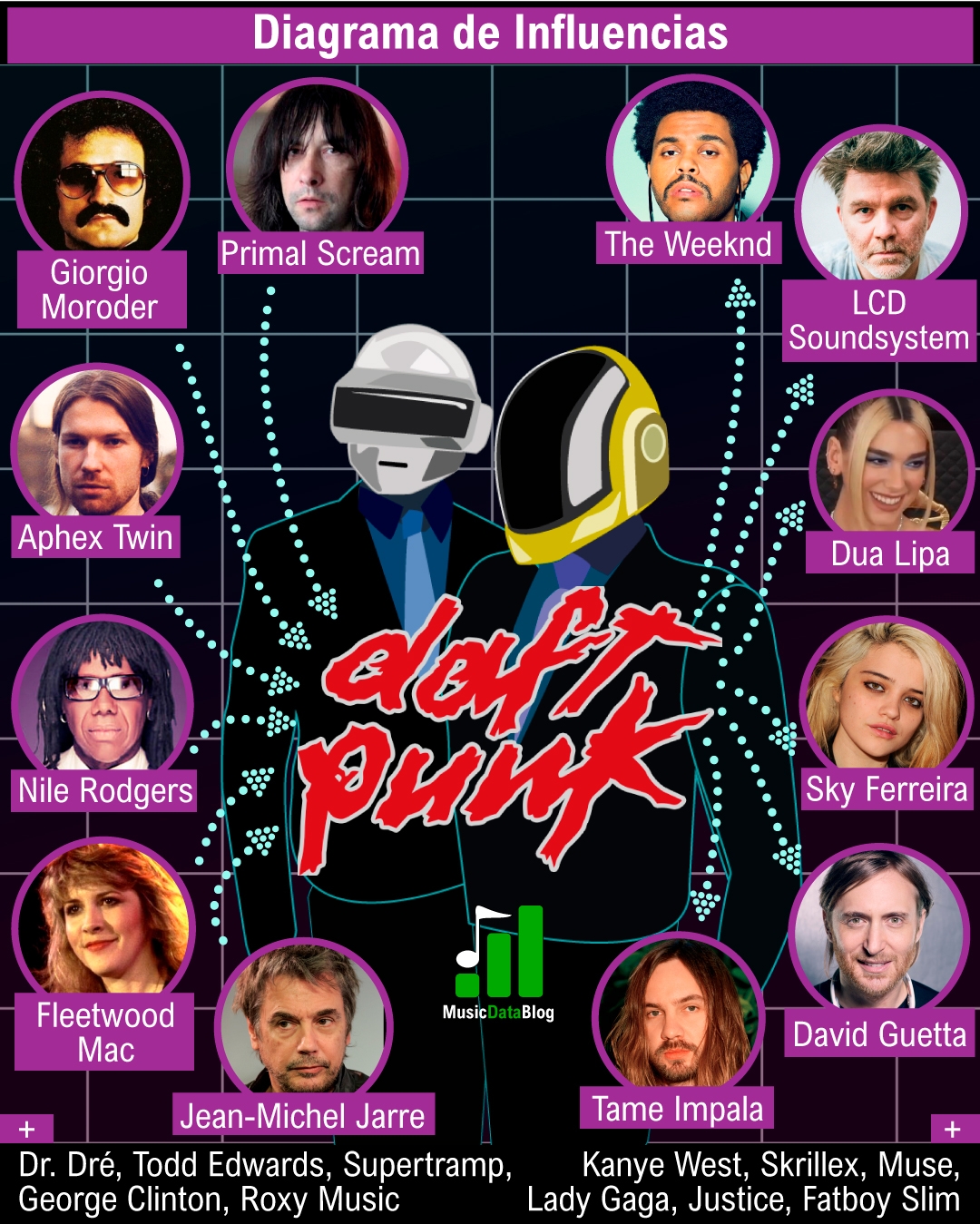
Daft Punk drew inspiration from a wide range of electronic and dance music pioneers, including Aphex Twin, DJ Todd Edwards, disco pioneer Giorgio Moroder, and funk acts such as Chic and George Clinton.
The French electronic duo also showcased cinematic and futuristic influences, particularly through projects such as Tron: Legacy. But here we’ll focus on the musical artists and records that shaped the Daft Punk style and sound.
Giorgio Moroder
One of Daft Punk’s most important musical influences was Giorgio Moroder, who is often referred to as the “father of disco.” With a prolific career during the 1970s, Moroder helped bring a more human dimension to synthesizer-based music. His work became a cornerstone for techno and dance-pop, making him one of the most important musical references for the French duo.
Daft Punk eventually brought Moroder into the studio for their final album, Random Access Memories (2013), where he appeared on the track Giorgio by Moroder, a tribute to his own musical legacy.
Nile Rodgers
Moroder wasn’t the only major influence on Homem-Christo and Bangalter. In an interview with Spin Magazine, Daft Punk also cited Nile Rodgers and Kraftwerk as important references.
It’s no coincidence that the duo’s first major hit, Around the World, drew heavily on the sound of Chic. Chic’s leader, Nile Rodgers, would later become another key collaborator on Random Access Memories. With that album, Daft Punk wanted to make music they themselves would want to hear on the radio and, in the process, remind listeners that both Moroder and Rodgers were still forces to be reckoned with.
Primal Scream
Guy-Manuel de Homem-Christo once explained to The Guardian that Primal Scream‘s Screamadelica (1991) opened up an entirely new set of possibilities for Daft Punk when they were getting started.
Primal Scream showed them that seemingly unrelated genres could be brought together—dub, disco, pop, and more—to create something fresh and unexpected. The Scottish band became one of the defining acts of the indie scene, combining sophisticated production with highly effective pop songwriting.
Aphex Twin
Aphex Twin is the kind of artist who makes you slightly uncomfortable, and that’s part of the point. In the best possible way, he challenges expectations through both his visual aesthetic and his music.
The English electronic pioneer pushed the boundaries of electronica, noise, and ambient music. Daft Punk have cited his track Windowlicker as an inspiration for the change in direction that led to their album Discovery.
Daft Punk wanted to move away from the sound of their debut album, and Aphex Twin‘s Windowlicker became something of a catalyst. Electronic music, they realized, didn’t have to be made simply for the dancefloor.
Jean-Michel Jarre
Guy-Manuel de Homem-Christo has also pointed to French electronic pioneer Jean-Michel Jarre as an important reference for Daft Punk.
Jarre’s album Oxygène (1976) wasn’t particularly well received when it first appeared, but over the years it developed both cult status and a much wider audience. Daft Punk have recalled listening to Jarre when they were young, making his music part of the sonic landscape that stayed with them as they developed their own sound.
Fleetwood Mac
Rock also played an important role in shaping Random Access Memories. Producer Todd Edwards, who collaborated in that album, told Rolling Stone Magazine that the LP was strongly influenced by Fleetwood Mac. He also broadens the sound inspiration to the “West Coast” sound associated with acts such as the Doobie Brothers and the Eagles.
Fleetwood Mac’s Rumours and Pink Floyd’s The Dark Side of the Moon were particularly important references, according to this article published by Billboard. There, Thomas Bangalter explains how Daft Punk developed the elaborate production and experimentation that defined their acclaimed 2013 final album.
There’s another interesting connection, too: both Daft Punk and their collaborators have expressed admiration for The Velvet Underground.
Another band worth mentioning is Supertramp, particularly in connection with Digital Love. But the influence goes beyond a single song. The Wurlitzer piano became an important part of Daft Punk‘s sonic palette, drawing on the sound of the progressive-rock band led by Rick Davies since the 1970s.
Roxy Music
Roxy Music were another important influence on Daft Punk, particularly through their pioneering combination of glam and art rock.
Led by Bryan Ferry, the band created a distinctive blend of sophisticated, sometimes baroque arrangements and highly effective pop songwriting. Tracks such as Pyjamarama offer an early example of the kind of genre-blending that Daft Punk would later take in a very different direction.
It’s also worth noting that Roxy Music were a major influence on Nile Rodgers and Chic, creating another link between Daft Punk‘s influences and the musicians who would eventually collaborate with them.
George Clinton, Dr. Dre, Romanthony, and DJ Todd Edwards are among the many artists Daft Punk name-check on Teachers, from their 1997 debut album Homework.
Which Artists Did Daft Punk Influence?
Daft Punk themselves became a major influence on artists ranging from their electronic contemporaries Fatboy Slim and David Guetta to modern pop stars such as Dua Lipa, The Weeknd, and Kanye West.
The French duo’s career was built around collaboration, and Random Access Memories in particular brought together many of the artists who had influenced them with musicians who had, in turn, been inspired by Daft Punk.
David Guetta
Much of 21st-century dance music owes something to Daft Punk‘s influence. David Guetta has gone on the record about how importan Daft Punk’s music is to him. Their sleek, irresistible approach to dance music certainly inspired him.
Daft Punk helped Guetta realize that he could create compelling electronic music without needing an enormous, state-of-the-art studio. He has also singled out Daft Punk’s debut album, Homework (1997) as a groundbreaking record that helped redefine electronic music as the new millennium approached.
LCD Soundsystem
LCD Soundsystem‘s first major hit was, appropriately enough, Daft Punk Is Playing at My House. On Losing My Edge, James Murphy famously sings about “showing Daft Punk to the rock kids.”
LCD Soundsystem approached the same territory as Daft Punk, but from a different angle. They brought dance music and rock together in a way that felt both complementary and fresh. When that formula works, the result can be remarkably effective.
If you’re looking for that same vibe—and perhaps want to miss the French duo a little less—LCD Sonundsystem’s Sound of Silver (2007) is a good place to start.
Sky Ferreira
Sky Ferreira explained in an interview that working with Daft Punk was one of her dreams, largely because she wanted the chance to learn from them. The California singer’s indie sound combines elements of rock, pop, and electronic music, resulting in a stylistic blend that owes something to the pioneers of modern disco and dance music.
Ferreira even had the opportunity to interview both members of Daft Punk, Guy-Manuel de Homem-Christo and Thomas Bangalter.
Lady Gaga
When she began working on her album Chromatica (2020), Lady Gaga explained to Rolling Stone Mag that she tried to build songs by deconstructing Daft Punk’s music. Her goal was to capture a classic sound while making it feel contemporary. And what better description is there for Daft Punk’s aesthetic than vintage and futuristic at the same time?
The Weeknd
The Weeknd had the rare opportunity to collaborate with Daft Punk twice, on his tracks I Feel It Coming and Starboy.
After the duo announced their breakup in 2021, The Weeknd said that Daft Punk were the reason he started making music, highlighting just how important their influence had been on his career.
Dua Lipa
Another major pop artist of the moment, Dua Lipa owes part of the success of Future Nostalgia to Daft Punk. Many reports on the media commented that her sound was deeply rooted in the French Duo’s legacy, and in a really good (and commercially successful) way.ç
One can’t help but wonder whether Dua Lipa mentioned she wishes to collabore with the creators of Get Lucky at some point in her career.
Tame Impala
Following the announcement of Daft Punk‘s breakup, Tame Impala’s frontman Kevin Parker described the duo as a major inspiration. Within the indie scene, Tame Impala carved out its own territory with psychedelic pop songs that frequently rely on synthesizers and electronic textures—elements that often bring Daft Punk to mind.
Other artists who owe something to Daft Punk include techno DJ Skrillex, former Housemartins member Fatboy Slim, and the futuristic reinvention of Muse, particularly on their more recent album Simulation Theory.
French electronic duo Justice and Kanye West are also among the artists influenced by Daft Punk. And, of course, the list could go on.
Learn More About Artists Related to Daft Punk
- Discover Massive Attack’s musical influences
- Explore Bjork’s career timeline
- Dive in deep into Radiohead’s influences and legacy