
'%3E%3Cg%20id='d'%3E%3Cg%20id='c'%3E%3Cg%20id='b'%3E%3Cpath%20id='a'%20stroke-width='1.3'%20d='m1%202%2034%2074%202%201v-2L9-2M8%2027c0%2011%207%2018%206%2028s5%2016%206%2020v7c1%201%204-3%203-8-1-6-5-7-4-20%201-12-5-15-4-26'/%3E%3Cuse%20href='%23a'%20transform='rotate(23)'/%3E%3C/g%3E%3Cuse%20href='%23b'%20transform='rotate(45)'/%3E%3C/g%3E%3Cuse%20href='%23c'%20transform='rotate(90)'/%3E%3C/g%3E%3Cuse%20href='%23d'%20transform='rotate(180)'/%3E%3Ccircle%20r='34'%20stroke-width='2'/%3E%3C/g%3E%3C/svg%3E)

Depeche Mode’s distinctive blend of electro-pop and rock had a profound impact on artists across a wide range of genres. Here, we take a look at some of the key influences that helped shape their sound, as well as the artists who later drew inspiration from them.
Depeche Mode emerged in Essex, England, in 1980. The band’s lineup currently consists of vocalist David Gahan and multi-instrumentalist and songwriter Martin Gore. Keyboardist Andy Fletcher, who was also a founding member, passed away in late May 2022.
Let’s take a closer look at the artists who helped shape Depeche Mode’s musical identity, and at the band’s lasting impact on the music that followed.
Which Artists Influenced Depeche Mode’s Sound?
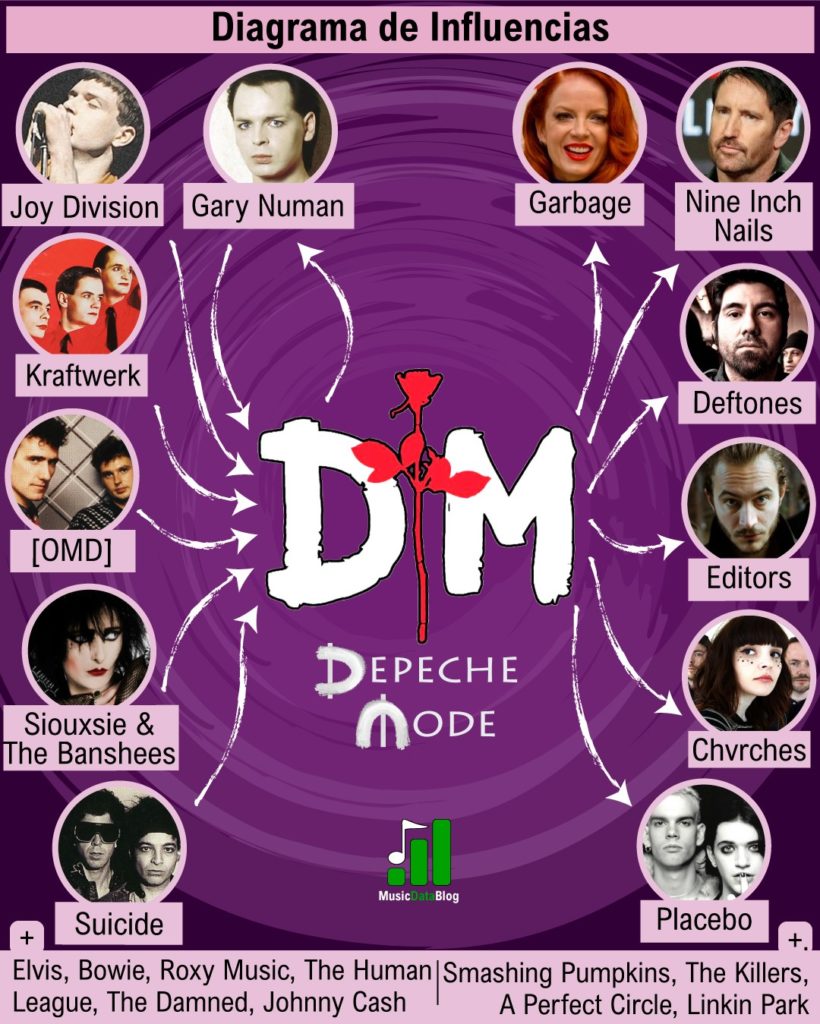
Throughout their career, Depeche Mode have developed a distinctive form of electronic pop and rock, often marked by dark and atmospheric themes. Their sound draws on a remarkably diverse group of artists, including Gary Numan, Siouxsie & The Banshees, Joy Division, Kraftwerk, Suicide, Ultravox, Orchestral Maneuvers in the Dark (OMD), Johnny Cash, The Damned, The Human League, and Roxy Music.
Joy Division
When it comes to Depeche Mode’s darker influences, Joy Division is an obvious place to start. They had a profound impact on the development of post-punk and dark rock, and there are clear parallels between their career and Depeche Mode’s trajectory.
David Gahan‘s baritone voice bears similarities to the deep, resonant vocals of Joy Division‘sm lead singer, Ian Curtis. But the connection goes beyond their vocalists. As we explored in our article on Joy Division’s influences, both bands played an important role in the evolution of gothic and electronic rock.
Also, Martin Gore‘s dark and atmospheric songwriting for Depeche Mode was particularly shaped by the world Joy Division had helped create.
Kraftwerk
Few groups have been as important to the development of electronic music as Kraftwerk. The German pioneers are widely regarded as innovators of synthesizer-based music and precursors to the techno beats that would emerge later.
When explaining their creative process, Martin Gore explained that Depeche Mode wanted to combine songwriters such as Neil Young and John Lennon with the musical arrangements of Kraftwerk. In other words, Gore was looking in two directions at once: toward the great figures of pop, rock, and folk, and toward the futuristic aesthetic and electronic experimentation of the German Krautrock pioneers.
Martin Gore’s goal, as he put it, was to make “soul music with electronic instruments.”
Orchestral Maneuvers in the Dark
Orchestral Maneuvers in the Dark (OMD) emerged in 1978, just two years before Depeche Mode and played a major role in bringing synth-pop into the mainstream. This particular group helped demonstrate that a band didn’t need to rely on the traditional guitar-bass-drums setup. Synthesizers could become the foundation of an entirely new kind of pop music.
It’s founding member Vince Clarke has a say on this: As one of the genre’s early pioneers, OMD helped define one of the stylistic directions Depeche Mode would explore.
Clarke left Depeche Mode after their debut album, Speak & Spell (1981), and went on to form two other influential electronic acts, Erasure and Yazoo.
Another major synth-pop reference for Depeche Mode was The Human League.
Siouxsie & The Banshees
The musical and cultural impact of Siouxsie Sioux is difficult to overstate. As an icon of the dark and post-punk scenes, she became an important reference point for generations of alternative artists.
According to lead singer Dave Gahan, he regularly attended Siouxsie & The Banshees concerts because he found their music exciting. Siouxsie‘s sensual, highly expressive vocal delivery also made her an important influence on later singers, him included.

Suicide
The synth-punk duo Suicide emerged in New York in the late 1970s. Their stripped-down, confrontational approach to electronic music had a lasting impact on the bands that followed.
Martin Gore once summed up their importance perfectly: “Before Suicide, the synthesizer was a clean-sounding instrument. They brought the punk element.”
Later, keyboardist and arranger Alan Wilder, who was part of Depeche Mode from 1982 to 1995, helped the band explore another technique that echoed Suicide‘s work: sampling guitars and manipulating their sound to create something entirely different from a conventional guitar performance.
Gary Numan
From his early work with Tubeway Army, Gary Numan established himself as a cult figure in electronic music. Songs such as Are ‘Friends’ Electric? and Cars showcased a robotic, synth-driven sound that proved highly influential on the emerging electronic and synth-pop scenes.
As Four Culture notes, Numan‘s music was an important reference for Depeche Mode, and Martin Gore and Andy Fletcher were particularly fond of his 1984 album Berserker.
And here’s an interesting fact: the influence eventually came full circle. Years later, Gary Numan acknowledged that Depeche Mode had inspired him in turn, particularly as he began writing darker material.
–
Other artists who influenced Depeche Mode include Sparks, Suicide, The Damned, Ultravox, Neil Young, and Johnny Cash.
Which Artists Were Influenced by Depeche Mode?
Depeche Mode became an enormously influential and successful act, particularly from the late 1980s through the 1990s. Their impact reached well beyond synth-pop and electronic music.
Bands such as Deftones, Nine Inch Nails, Placebo, Smashing Pumpkins, Garbage, Chvrches, Muse, Editors, The Killers, and Linkin Park have all cited Depeche Mode as an inspiration. Llet’s now have a look.
Deftones
Deftones frontman Chino Moreno told Roling Stone Magazine that Depeche Mode as one of his strongest influences, even crediting the band with inspiring him to start making music in the first place. The connection became even more apparent as Deftones moved beyond their early nu-metal sound. Beginning with their acclaimed 2000’s album White Pony, the band embraced a more experimental approach, incorporating darker atmospheres and layered textures into their music.
Depeche Mode was clearly one of the reference points behind that evolution, helping Deftones bridge the gap between alternative metal, electronic music, and atmospheric rock.
Nine Inch Nails
It’s hard to hear Nine Inch Nails‘ debut album, Pretty Hate Machine (1989), without noticing the influence of Depeche Mode. The album combines strong electronic and pop influences with prominent rock guitars and industrial beats, creating the distinctive sound that would define Nine Inch Nails.
As Stereogum reported, The band’s mastermind, Trent Reznor, drew inspiration from Depeche Mode’s Black Celebration tour in 1986 while beginning work on what would become his project’s debut album.
Synth-pop and industrial elements would remain recurring threads throughout Nine Inch Nails‘ career, even as the band’s sound continued to evolve. You can read more about NIN’s musical influeces here.
Chvrches
One of the most prominent synth-pop groups of the modern era, Chvrches have openly acknowledged Depeche Mode as an influence.
All three members—Lauren Mayberry, Iain Cook, and Martin Doherty—are fans of the band. They have also explained that Depeche Mode and The Cure were the two main influences behind their album Love Is Dead (2018).
Placebo
“We were trying to sound like Sonic Youth and Depeche Mode,” Placebo singer Brian Molko once explained to Vice Magazine.
When Placebo emerged in the early 90’s, they deliberately set themselves apart from the dominant Britpop scene of the mid-1990s. Their alternative, highly textured sound—and even their visual aesthetic—had much in common with Depeche Mode.
The connection became particularly explicit when Placebo recorded their own version of Depeche Mode’s classic I Feel You.
Garbage
One of the most successful bands of the second half of the 1990s, Garbage fronted by the charismatic and outspoken Shirley Manson. Their 1995’s self-titled debut can be described as dark electronic rock, with a sound that often recalls the more guitar-driven side of Depeche Mode.
Both bands are known for their meticulous approach to songwriting and production, making extensive use of the recording studio as part of the creative process.
We have also published Garbage’s influences diagram, where we explore the connection between the two bands, as well as many others.
Editors
Although English band Editors initially emerged from the post-punk scene, they began incorporating more prominent electronic elements on their third album, In This Light and on This Evening (2009). In conversation with The Quietus, singer Tom Smith acknowledged that the band are fans of Depeche Mode, specifically citing them as an inspiration for that album.
On later records such as In Dream (2015) and Violence (2018), Editors took Depeche Mode’s electronic influence even further. With less emphasis on the traditional instrumentation associated with rock bands, they combined guitars, synthesizers, and samples to reshape their sound, drawing inspiration from Depeche Mode classics such as Violator (1990).
–
Other bands influenced by Depeche Mode include Linkin Park, A Perfect Circle, Smashing Pumpkins, The Killers, and Paramore, among countless others.