
They brought punk into the mainstream, but… can they really be considered a punk band? The history of Green Day is the story of three California kids who came up through the state’s underground scene and eventually found the formula for mainstream success.
Punk or not, that’s how you feel. Scroll down to explore the history of Green Day:

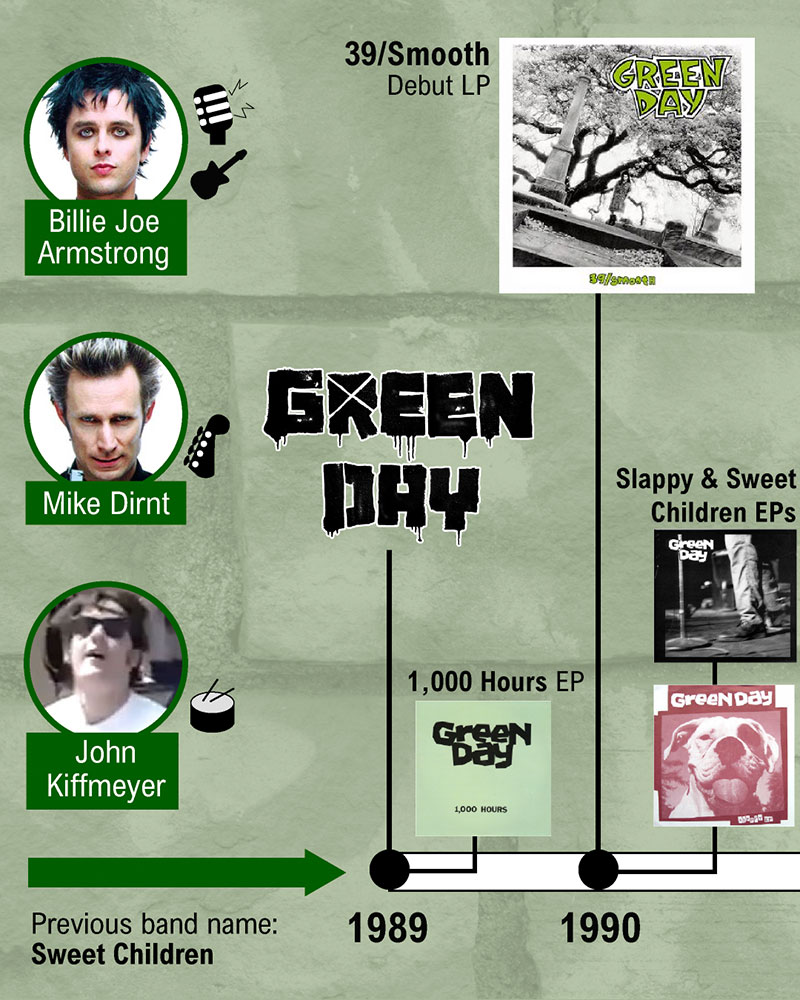
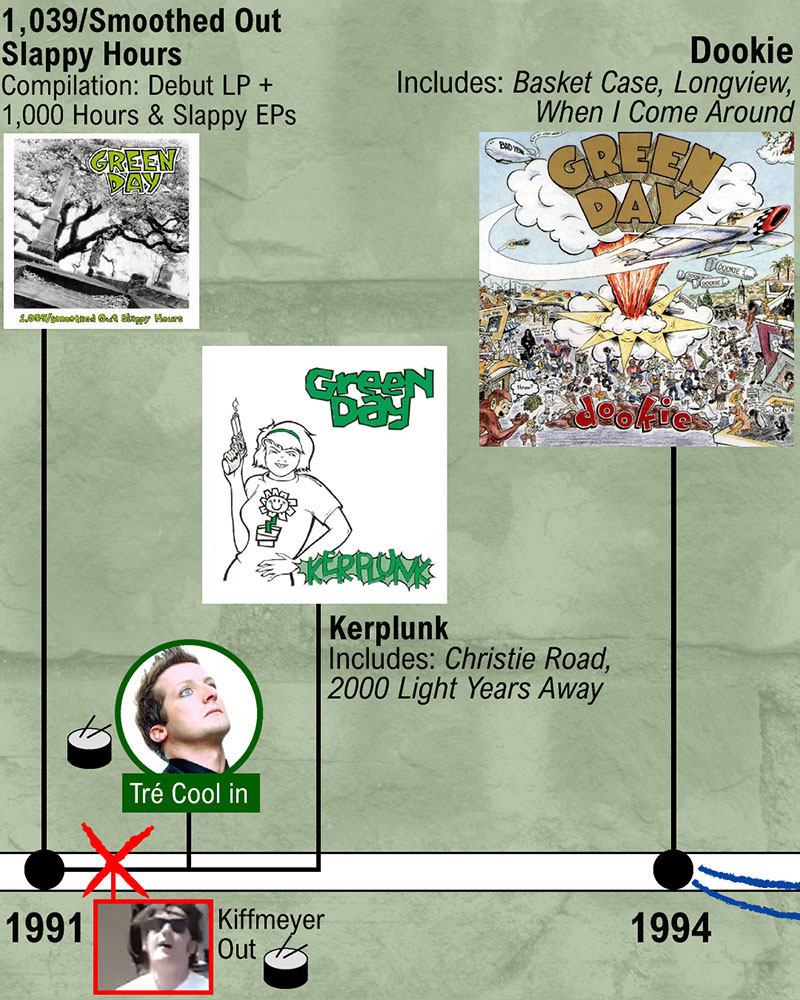
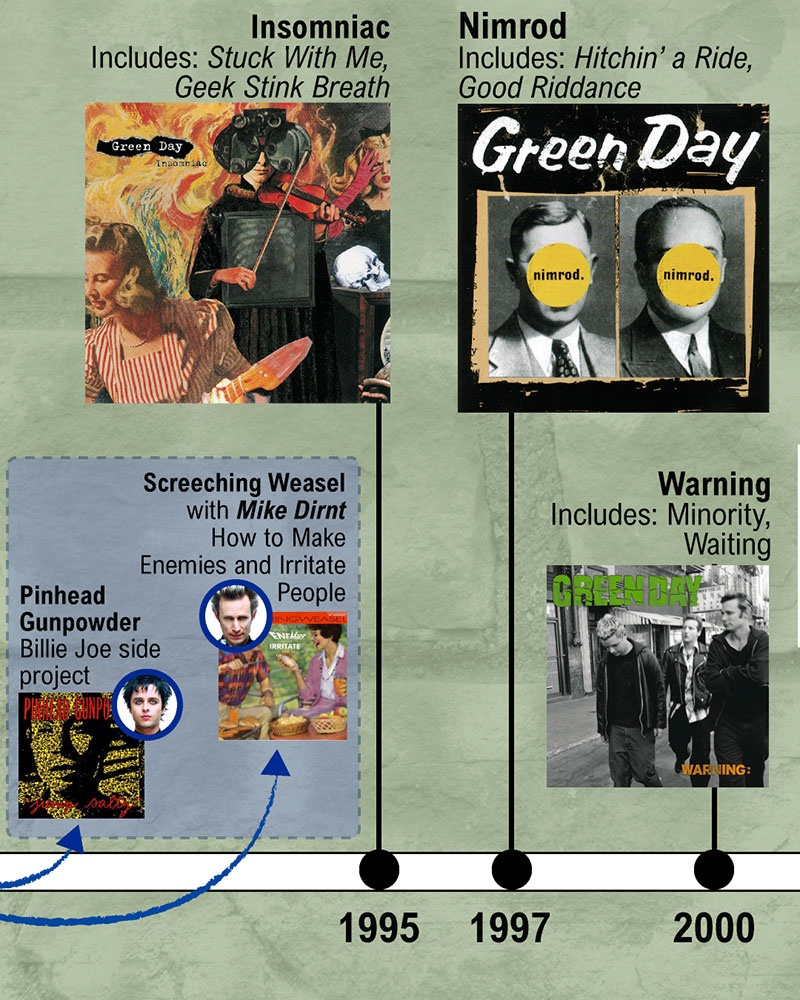
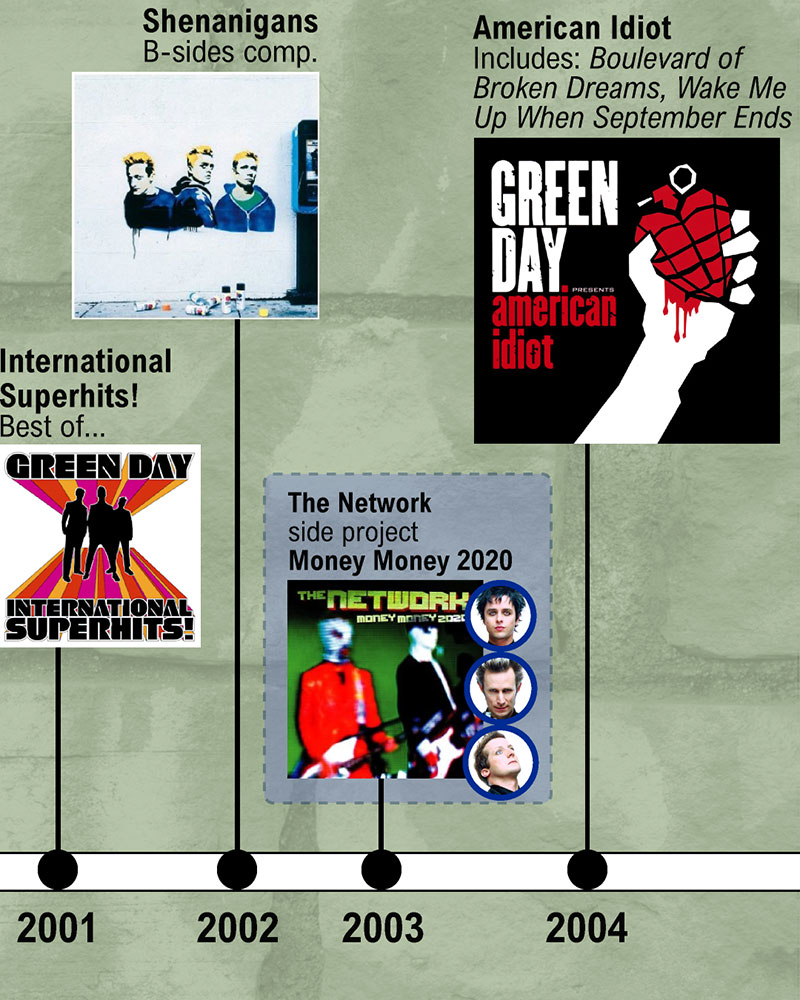
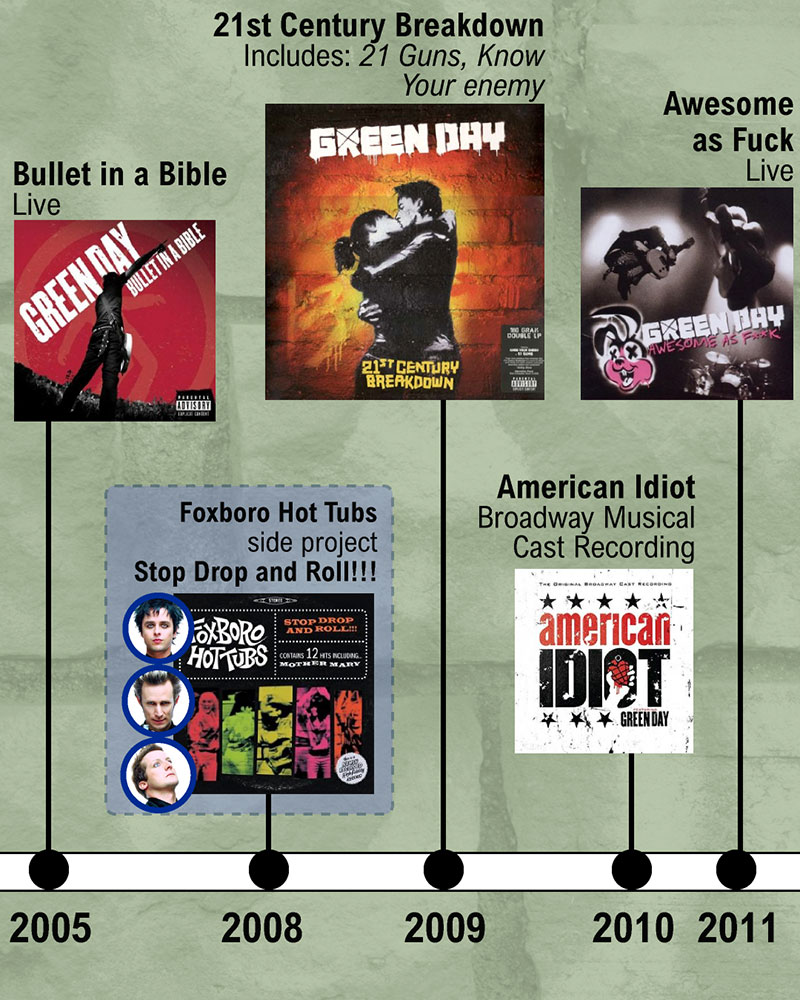
Green Day are a California punk rock band whose story began in the late 1980s. Over the course of their career, the band has released 14 studio albums. To sum up the history of Green Day in a few words, their first major peak came in the mid-1990s with Dookie, Insomniac, and Nimrod, released between 1994 and 1997.
After a brief commercial stumble with Warning in 2000, Green Day returned to the spotlight with their biggest album to date: American Idiot, released in 2004. Its follow-up, 21st Century Breakdown (2009), was also successful, although it did not reach the same heights.
Since 2012, the Green Day albums have generally been more uneven in terms of both critical and commercial impact.
The Early Years of Green Day (1989–1993)
Green Day were founded in 1989 by singer and guitarist Billie Joe Armstrong and bassist Mike Dirnt, alongside their original drummer John Kiffmeyer.
After recording several EPs, the band released their debut album, 39/Smooth, through Lookout Records in 1990. The record was reissued a year later with additional material from their EPs and retitled 1,039/Smoothed Out Slappy Hours.
In 1990, John Kiffmeyer left Green Day and was replaced by Tré Cool. This established the classic three-piece lineup that would define the band for most of its career.
In 1991, Green Day released their second album, Kerplunk. The band was still firmly rooted in the local underground scene. They had already built a loyal following, but worldwide recognition would not arrive until their next album.
Green Day Become an International Success (1994–1998)
In 1994, Green Day signed with major label Reprise Records, a move that earned them plenty of criticism from the California punk scene, where many accused the band of having “sold out.” That same year, Dookie hit stores and became a massive commercial success, powered by songs such as Basket Case and When I Come Around.
The following year, in 1995, the band released Insomniac. It was heavier and more abrasive than Dookie while remaining firmly rooted in the band’s established sound. Although it was less commercially oriented, the album still produced well-known singles such as Walking Contradiction and Brain Stew.
With Nimrod in 1997, Green Day began pushing their sound in new directions. Tracks such as Hitchin’ a Ride, King for a Day, Last Ride In, and the massive hit Good Riddance (Time of Your Life) showed that the band could incorporate ska, alternative rock, acoustic textures, and other influences into their music. At the same time, the album still contained plenty of classic Green Day material, including Nice Guys Finish Last and Jinx.
Green Day’s Crisis and Resurrection (2000–2010)
By 2000, Green Day were exhausted and seemed uncertain about where to take their music next. The result was Warning, a relatively uninspired album that lacked the energy and memorable songwriting of their earlier work. Even songs such as the title track failed to capture much attention from the public.
There was, however, an important exception: Minority offered the first clear indication that Green Day were ready to explore more overtly political territory in their lyrics—something that would become far more prominent on their subsequent records.
The years 2001 and 2002 were largely devoted to compilations. The band released the greatest-hits collection International Superhits!, followed by Shenanigans, a compilation of B-sides and other previously unreleased material.
In 2003, Green Day also launched their new-wave side project The Network, releasing the album Money Money 2020.
The band’s return to the top came with American Idiot in 2004. A distinctly political concept album, the record told the story of the character St. Jimmy while tackling a broader sense of disillusionment with American society and politics.
Driven by hits such as American Idiot, Boulevard of Broken Dreams, and Wake Me Up When September Ends, Green Day reclaimed their position near the top of the charts.
In 2008, the band secretly worked on another side project: the garage rock group Foxboro Hot Tubs. They released a single album, Stop Drop and Roll!!! Although it received relatively little promotion, the project offered a refreshing change of pace and another glimpse at the musicians’ broader influences.
In 2009, Green Day released 21st Century Breakdown, essentially a thematic successor to American Idiot. While it was less successful than its predecessor, it nevertheless confirmed that Green Day remained a major force in rock. Songs such as 21 Guns and Know Your Enemy became the album’s main commercial singles.
Green Day’s Trilogy and Commercial Decline (2012 – 2020)
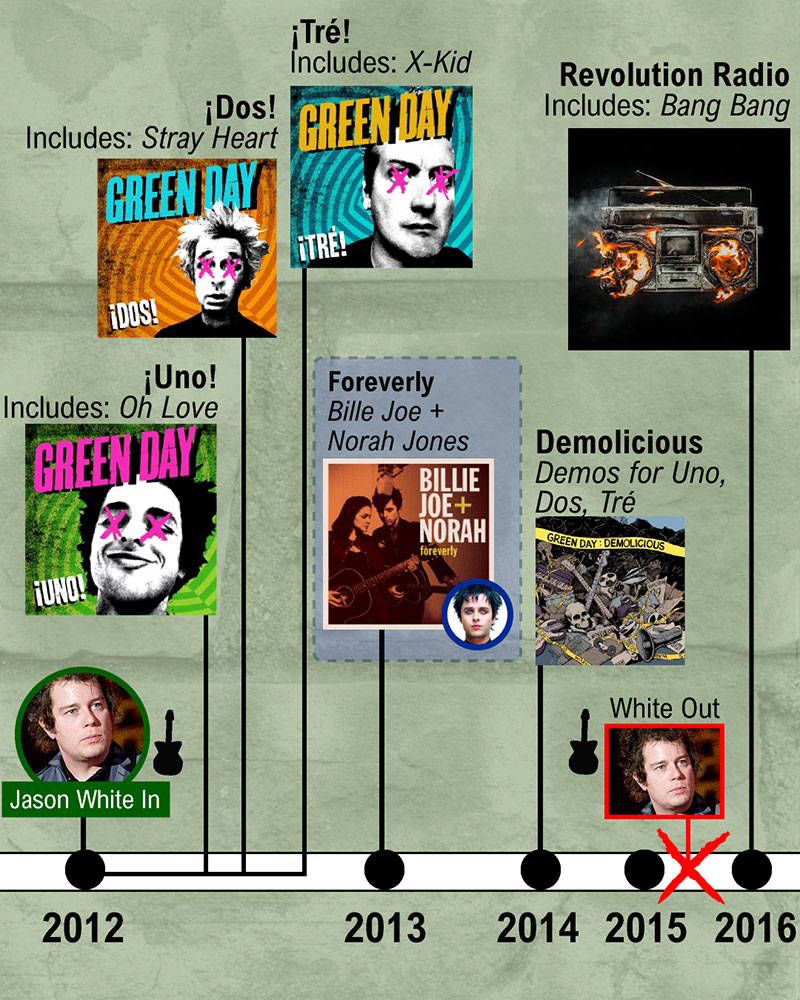
In 2012, Jason White joined Green Day as a guitarist. White had been working with the band for several years as a touring and session musician, and his addition expanded Green Day from a trio into a four-piece lineup.
After 21st Century Breakdown, however, Green Day’s output failed to match the impact of their earlier work.
That same year, in 2012, the band released a trilogy of albums: ¡Uno!, ¡Dos!, and ¡Tré! None of the three records made a particularly strong impression on critics or audiences. Their singles received limited radio exposure, and the trilogy as a whole failed to demonstrate the consistency and songwriting strength Green Day had displayed on their most successful albums.
In 2015, after having been an official member of Green Day only during the period surrounding the trilogy, Jason White left the band. He continued to work with Green Day as a session musician and additional live guitarist.
In 2013, Billie Joe Armstrong and Norah Jones released the collaborative album Foreverly.
Green Day returned in 2016 with Revolution Radio, an attempt to recapture the politically charged spirit they had established with American Idiot. The album, however, failed to reproduce the cultural impact of their 2004 breakthrough.
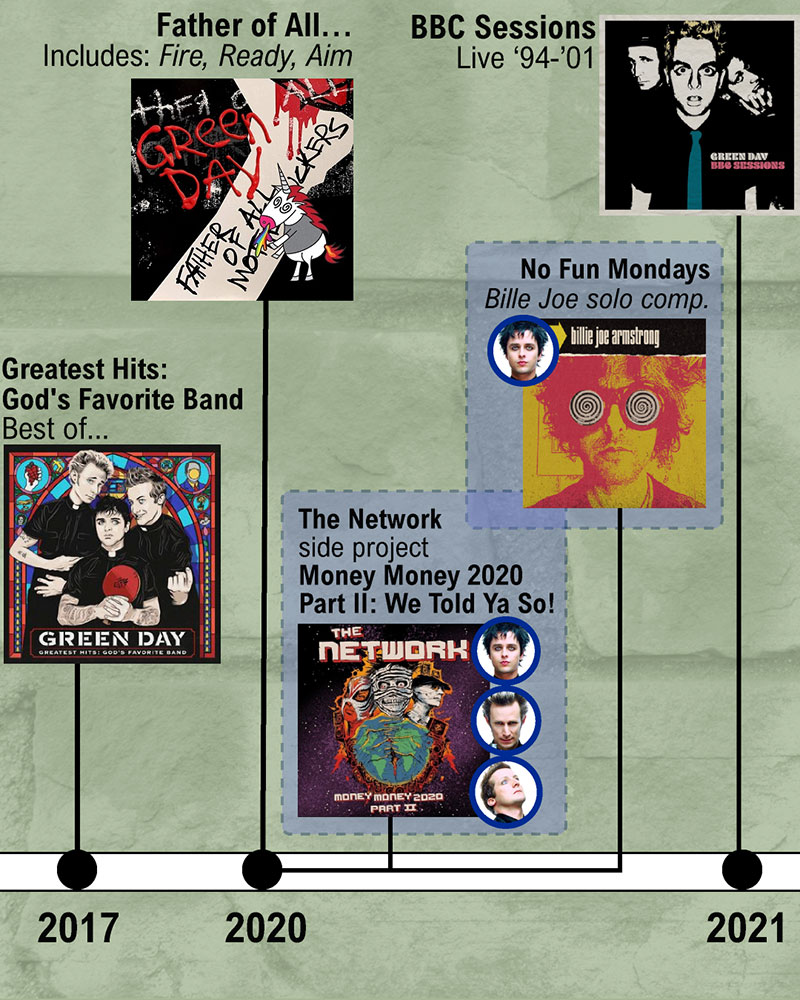
In 2020, the band released Father of All Motherfuckers, which received a lukewarm commercial response and was characterized by a softer sound and relatively weak production.
Meanwhile, the new-wave project The Network released its second album, Money Money 2020 Part II: We Told Ya So. Billie Joe Armstrong also developed his pandemic-era home-recording project No Fun Mondays, which was released as an album in 2020.
Is was after those commercial flops, that the band decided to stop trying too hard to stay relevant, and instaed lean on their legacy. After all, they have done an amazing run of records back in their heyday.
Green Day Reclaim Their Legacy (2024 – Present)
That opens what seems to be the latest chapter in their career, eventjhough they haven’t call it quits. But they just stoped trying to force things.
In 2024, Green Day released Saviors, which seemed a much decent effort than their more recent output. The record was well received by both fans and critics, although it did not quite reach the heights of the band’s finest work.
In 2026, Nimrods, a fictionalized biopic inspired by Green Day’s history, is set to be released. Its soundtrack features songs from different periods of the band’s career, along with the new single I’m Never Gonna R.I.P. and tracks by other artists.