
The Who are one of the most influential British rock bands to emerge in the mid-1960s. Their sound evolved from the power pop and mod scenes of the era, eventually helping lay the groundwork for heavy metal, punk, and progressive rock.
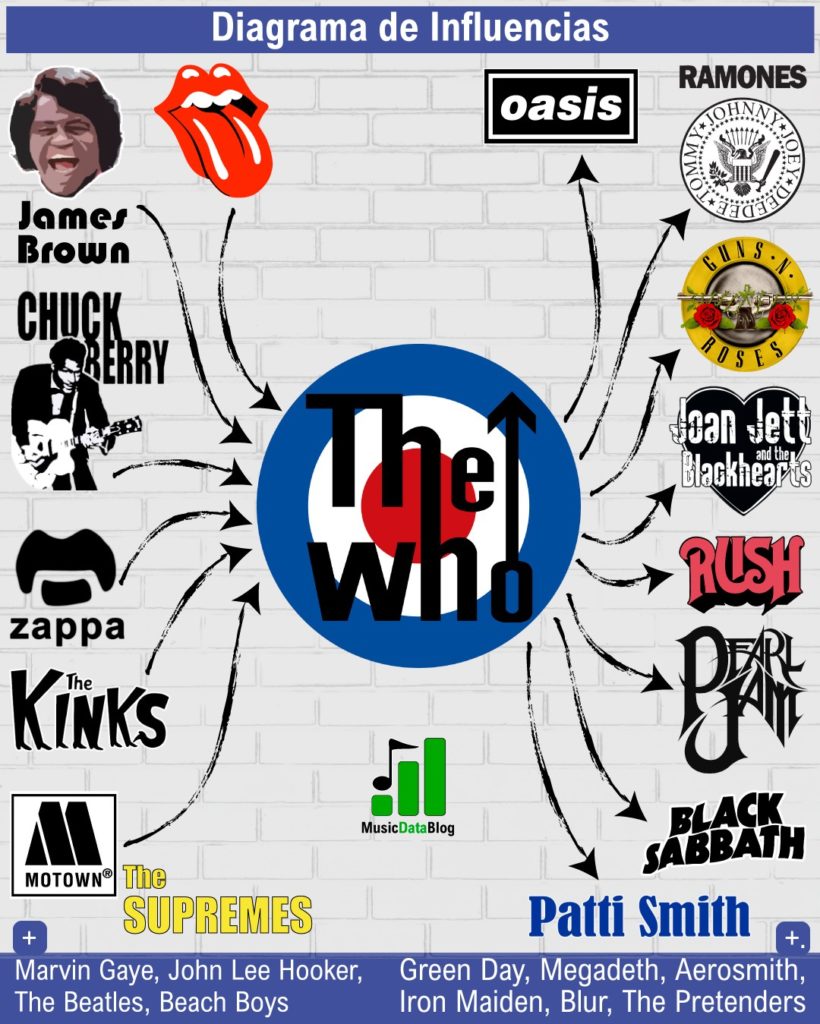
What artists influenced The Who?
The Who drew inspiration from the blues and early rock ’n’ roll, particularly artists such as John Lee Hooker, Bo Diddley, and Chuck Berry. They were also influenced by major British and American acts including The Beatles, The Rolling Stones, and The Beach Boys. Other important influences included Jimi Hendrix, The Kinks, Frank Zappa, James Brown, and Joni Mitchell.
To understand where The Who’s sound came from, it helps to look at both their immediate musical influences and the broader scene they emerged from. Tha band formed in the mid-1960s, led by guitarist Pete Townshend and featured Roger Daltrey on vocals, John Entwistle on bass, and Keith Moon on drums.
What can we say about their style in the mid 60s? Their early sound reflected the explosive rock culture of the era, when bands such as The Beatles and The Rolling Stones were reshaping the popular music landscape.
The Rolling Stones (+ The Beatles)
The Rolling Stones stand out as a particularly important influence on The Who, not only musically but also because of the close relationship between the two bands. The Who performed versions of Stones classics such as “Under My Thumb” and “The Last Time.”
Accordint to this interview in Far Out Mag, Pete Townshend also felt that The Who were often overshadowed by The Rolling Stones, something he addressed in the song “Substitute.” The chorus even features Townshend singing in an imitation of Mick Jagger’s voice. In 1989, Townshend also delivered a heartfelt speech during The Rolling Stones’ induction at the Rock & Roll Hall of Fame.
There is also an interesting connection in the other direction: Paul McCartney was reportedly inspired by The Who’s “I Can See for Miles” when writing “Helter Skelter,” one of The Beatles’ heaviest recordings.
The Kinks
The Kinks were another key contemporary influence on The Who during the mid-1960s. The connection is especially clear in “I Can’t Explain,” whose sound bears a direct resemblance to The Kinks’ early style, as stated in Townshends official website.
Pete Townshend has spoken about Ray Davies’ importance to British rock, describing how Davies helped create a new approach to poetry and songwriting within the genre. Roger Daltrey has likewise recalled how The Kinks’ distinctive pop sound immediately caught The Who’s attention.
Chuck Berry
Chuck Berry, one of the architects of rock ’n’ roll, was another major influence on Pete Townshend’s songwriting and guitar playing.
Berry is often cited as an influence on guitar technique, but his impact on Townshend went beyond the instrument itself. When asked about this by Far Out Magazine, Townshend answered that listening to Chuck Berry helped him understand the importance of putting greater emphasis on lyrics and songwriting.
Frank Zappa
Frank Zappa’s influence on The Who is particularly connected to the band’s double concepot album Quadrophenia.
Around 1972–73, Pete Townshend was frustrated after failing to move forward with his ambitious conceptual project Lifehouse and struggling to find a suitable follow-up to Tommy. Zappa encouraged The Who to approach their next project more like a narrative soundtrack.
That idea eventually helped point Townshend toward Quadrophenia, the ambitious double album that became one of The Who’s defining works.
Artistas de Motown: The Supremes, The Temptations
Motown was another major influence on The Who, particularly during their early years. Much of that sound was built around the work of The Funk Brothers, the studio musicians who provided the instrumentation behind many of Motown’s classic recordings.
Their playing shaped records by artists such as Marvin Gaye, The Temptations, and The Supremes—the legendary female trio that launched Diana Ross’ career.
The Motown influence is especially noticeable on The Who’s debut album, but elements of that style continued to appear throughout their music. Another important connection involves bassist James Jamerson, whose work with The Supremes and other Motown artists made him one of John Entwistle’s most important musical influences.
What bands were influenced by The Who?
The Who’s influence stretches across several generations and genres. Artists and bands inspired by their music include Pearl Jam, The Ramones, Green Day, Oasis, Guns N’ Roses, Rush, Aerosmith, Patti Smith, and Joan Jett. Their impact can also be heard in classic hard rock and heavy metal bands such as Iron Maiden, Megadeth, and Black Sabbath.
The Ramones
The Ramones were among the bands deeply influenced by The Who. That influence played a role in the development of punk rock, both in the United States and in the British scene that emerged in the late 1970s. Joey Ramone was a huge fan of The Who.
The connection eventually came full circle when The Ramones recorded their 1993’s album Acid Eaters with Pete Townshend contributing guitar to their version of “Substitute.”
We already covered this in detail in The Ramones Influence chart.
Pearl Jam
Eddie Vedder has long been a devoted fan of The Who. In 2008, Pearl Jam paid tribute to the band at the VH1 Rock Honors in 2008, when they performed two classics from the album Quadrophenia: “The Real Me” and “Love, Reign O’er Me.”
The Who’s influence can also be heard throughout Pearl Jam’s catalog, particularly on albums such as Vitalogy (1994) and Backspacer (2009). We have more info about this on Pearl Jam’s influence chart.
Black Sabbath
The Who’s influence on Black Sabbath is particularly noticeable in the later albums the band recorded with Ozzy Osbourne. In this other article you can can check out Sabbath’s musical influences and their legacy.
On Sabbath Bloody Sabbath (1973), tracks such as “Looking for Today” and “Spiral Architect” reveal some of that influence, while echoes of The Who can also be found on Technical Ecstasy.
In conversation with Guitar World, Black Sabbath bassist Geezer Butler has also named My Generation as one of his favorite albums and has cited John Entwistle as an important influence on his own playing.
Guns n’ Roses
Guns N’ Roses guitarist Slash has cited The Who’s powerful and aggressive approach as an influence. He has particularly singled out Pete Townshend’s guitar style as an important reference point.
In an interview with Esquire, Slash explained that The Who’s influence also extends to the way they handled dynamics, moving between explosive passages and quieter sections to give their songs greater impact.
And by the way, yes… We also did a music influence chart about Guns n’ Roses, with The Who included.
Rush
As Rolling Stone Magazine notes, Rush took considerable inspiration from The Who, particularly through the work of legendary bassist John Entwistle. Rush‘s bass player and singer, Geddy Lee has described Entwistle as one of the bassists who influenced him most, calling him an early benchmark and explaining how The Who’s music helped push his own playing to another level.
In conversation with the magazine Guitar Player, guitarist Alex Lifeson has also pointed to Pete Townshend as an important influence on his approach to songwriting and guitar work.
Patti Smith
One of the defining figures of the proto-punk movement, Patti Smith turned her version of “My Generation” into something what The New York Time calls her “signature performance“. She recorded the song as a bonus track connected to her classic 1975 album Horses and has continued to perform it live. Smith’s interpretation is distinctly her own, taking the vocal intensity of Roger Daltrey’s original and pushing it in a more confrontational direction.
Few songs capture the spirit of punk quite like Patti Smith taking on “My Generation.”
You can also explore Patti Smith’s musical influences to see the wider musical lineage behind her work.
Joan Jett
After the short-lived success of The Runaways, Joan Jett launched her solo career with inspiration from artists including The Who.
Jett has specifically credited Pete Townshend with inspiring her to play guitar, particularly through his powerful, direct approach to the instrument. That influence became part of the foundation for Jett’s own guitar-driven sound and stage presence.